Prepare Your Emergency Go Bag Today
Stay one step ahead of a disaster later by taking steps to prepare now.
Preparing a go bag might seem like a little thing, but with just a few steps, you can ensure that you and your family have what you need in the event of an emergency or disaster.
True, none of us want to think that we will ever be in a position where we have to evacuate at a moment’s notice. Sadly, each year millions of people are displaced by things out of their control such as natural & man-made disasters, power outages, and more. Fortunately, many of these people were prepared with essential items and were able to leave the dangerous situation safely.
In this guide, we wanted to focus on preparing a go bag in a simple, easy-to-follow way. In just eight steps, you can prepare a go bag that is practical and works for most households.
Ready to get started? Let’s go!
Step 1 – Water and Food
Food and water are the most important things to have in your go bag. According to the survival rule of 3, we cannot survive three days without water and three weeks with food. While not an exact science, it does provide a general guideline for how long a person can go without these essential elements in a survival situation.
When it comes to food, there are various options that take into account nutrition, portability, shelf-life, and cost. Here is a list of recommendations:
As you consider these options, ensure that there is enough for everyone in the family. Other food options include trail mix, freeze-dried foods, or ready-to-eat meals.
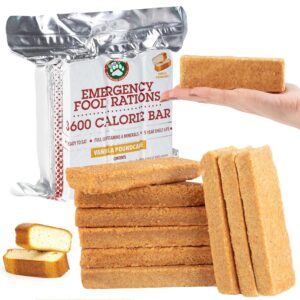
To learn more about food preparedness, visit the emergency food guide.
Water preparation has multiple options. While some might recommend one of the following options, we recommend all three for well-rounded preparedness:
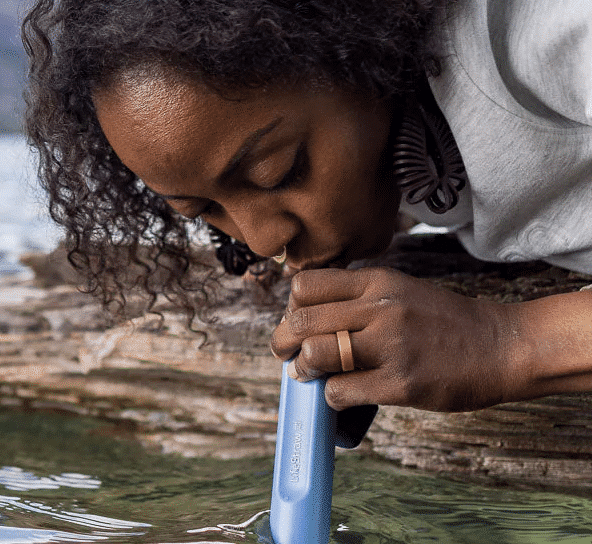
To learn more about water purification, visit our water purification guide.
By this point, you should have the food and water you need in your shopping cart. Now let’s move on to the next step.
Step 2 – Shelter and Clothing
So far so good, right? In this step, we are going to focus on another important part of any go bag. While according to the survival rule of 3, we cannot survive three days without water and three days with food, we also cannot survive 3 hours without shelter in extreme conditions. Having shelter is definitely a needed item for your go bag.

Shelter can come in different forms. Some of the most coming shelter items are:
- Tents: While we tend to think of tents as big and bulky, emergency shelter tents are lightweight and durable. The most common tents can fit two people. So if you have a family of four or more, consider buying multiple tents for your go bag.
- Blankets: We’re not talking about the comfortable blankets that are on your bed. For emergency situations, you will need something lightweight and functional. Emergency thermal blankets utilize a special material that protects from weather conditions by keeping one dry and retains up to 90% of a person’s body heat. Most of these come in packs of four, which makes it ideal for a family.
- Ponchos: Protecting from precipitation will keep one dry and prevent conditions such as hypothermia and shock.
- Bivy Sacks: Many people might now have heard of a bivy sack. Think of it as a weather resistant, lightweight sleeping bag. Like the tent and thermal blankets, these will keep you warm and take up little space in your go bag.
- Tarp: This is a fine alternative to tents, blankets, and bivy sacks as they are versatile and can be used in a variety of settings and ways.
Which one should you get? Ultimately, it comes down to preference. Since these take minimal space in a go bag, we have found that having a tent, thermal blankets, and ponchos to be the right level of coverage, portability, and usage. We recommend that you think about your family size and plan accordingly. For a deeper discussion on emergency shelter, please check out our Emergency Shelter Guide.
Having a change of clothing is a great idea. This includes having warm socks and a hoodie or light jacket. Since space is limited in a go bag, consider compression cubes.
Step 3 – Health and Hygiene
While it is our hope that no one gets hurt, accidents do happen. Because of that, first aid is important – not just for ourselves, but for others as well.
First aid kits are also an essential part of a go bag. A basic first aid kit should include:
- Bandages
- Aspirin
- Cold Compress
- Gloves
- Hydrocortisone Ointment
- Roller Bandages
- Tweezers
- Gauze Pads
- Antiseptic Wipes
- Cloth Tape
Buying a first aid kit is easier than assembling one, especially since there are so many viable first aid kits on the market.
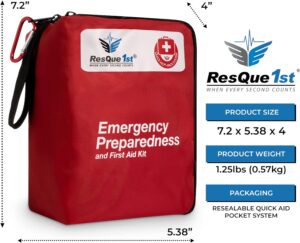
We recommend that you buy a first aid kit as opposed to creating one. There are so many viable first aid kits on the market that include all of the essential items and more in a compact package and good price. To learn more about first aid kits, take a look at our First Aid Kit Guide.
In addition to first aid kits, having essential medication, hand sanitizer, travel-size toiletries, and wet wipes will ensure that most of your hygiene needs are met.
Step 4 – Communication
Most of us have cell phones and in most situations, we will still be able to communicate and search the internet freely. However, as seen in other disasters, cellular service is not always ensured. So we need to consider what we will do if we aren’t able to use our smart devices.
One prime way to make sure we stay alert is to have an emergency radio. Emergency radios are just what the name implies – radios designed to be used in the event of an emergency. When the unexpected happens, staying informed with pertinent updates helps us stay prepared and ready if and when the need for decisive action is needed.
There are a wide range of emergency radios available on the market. It is important that you looking for ones that are specifically identified as emergency radios and not just AM/FM radio as these serve different purposes and have different features.
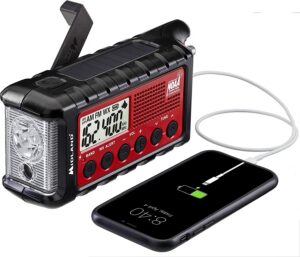
Features to look for in your emergency radio include:
- NOAA
- Charging either through DC, USB, solar panels, or hand crank
- Good reviews about reception
- Durability, size, and weight
- Waterproof
- Flashlight (bonus feature)
- Charger (bonus feature)
- Clock
More information about emergency radios can be found on our Emergency Radio Guide.
At this point, you are halfway done with creating your go bag and as promised, it wasn’t too bad. So what now? It’s time to talk about tools and safety.
Step 5 – Tools and Safety
Survival tools are anything that one needs in order to survive in the case of an emergency or disaster. Being that these events can be unpredictable, having the right set of tools to cover multiple situations is important.
While we cannot capture every tool one can have in their go bag, here is a list of survival tools and accessories we recommend packing:
- Pocket Knife Multitool
- Emergency Glow Light Sticks
- Masks
- Whistle
- Flashlight
- Tape
- Rope
- Portable Lighting
- Battery Pack
Seems like a lot, but each of these things take up little room in bag. However, if you want to make things a little easier, might we recommend a survival tool kit. These things are awesome because they are so versatile, contain so many items, and it’s compact enough to fit in your go bag.
Step 6 – Essential Documents
In the previous sections, we spoke about things needed for survival – food, water, and shelter. We spent time talking about communication and survival tools. Now, let’s take a moment to talk about essential documents to have in your go bag.
When told to flee, we only have a few moments to grab our bags and go. Time spent trying to gather documents could threaten our safety. So, it is best to take time now so we have that peace of mind later.
Essential documents include copies of:
- Your driver’s license, or other photo ID
- Social security cards
- Passports
- Medical ID cards, insurance information, or medical duration power of attorney (DPA) cards
- List of important phone numbers
- Copies of credit cards
- Copies of bank statements
For a more exhaustive list of important documents to have, check out FEMA’s list of critical documents to have in the case of an emergency. This checklist will allow you to mark off the items that you have and help you gather the documents that you haven’t packed.
Storing these documents is something that also needs to be considered. Having your files in a waterproof folder will protect them from the elements and keep them safe in your bag. A flash drive is also a good choice for storing files.
Step 7 – Bag
You can’t have a go bag without having… a bag. In this step, we are finally going to take all of the items you have purchased that are currently sitting on your living room floor or in your shopping cart and finally get a place to put them.
There are three main options when it comes to a bag. The options are:
- Backpacks – the preferred choice as it is easy to carry, can hold a lot of items, small enough to fit in a closet, and makes moving easier.
- Dufflebags – carries more than a traditional backpack, but not as comfortable and efficient as a backpack.
- Rolling Bags – good for older couples or those with back problems. The one we recommend in this category is also a backpack.
There are so many bags to choose from. It is best to determine what size bag works for you and your family. In some cases, it is practical to have more than one.
Step 8 – Other Useful Items
Now that we have covered the major items, let’s mention a few other items that would be worthwhile to have in your go bag. These include:
- List of emergency contacts and meeting places and a local map
- Credit cards and cash
- Extra set of house keys and car keys
- Paper, pens, and activities for children
- Extra set of clothes
- A Bible
Congratulations! You Did It!
If you made it to this point, you now have a complete go bag. These items will no doubt help you in the event of a disaster or emergency and will give you piece of mind.

In this guide, we covered a wide range of go bag essentials. If you haven’t already, prepare now. Spending a moment now is a moment saved later.
What should you do now? Tell others about the Go Bag Guide so that they too can prepare a go bag. Look over our other guides including the ones on disaster preparedness.
We here at Go Bag Guide thank you for reading this guide and hope that you found this information helpful.
—